
AD ASTRA – KAGUYAHIME
AD ASTRA – KAGUYAHIME
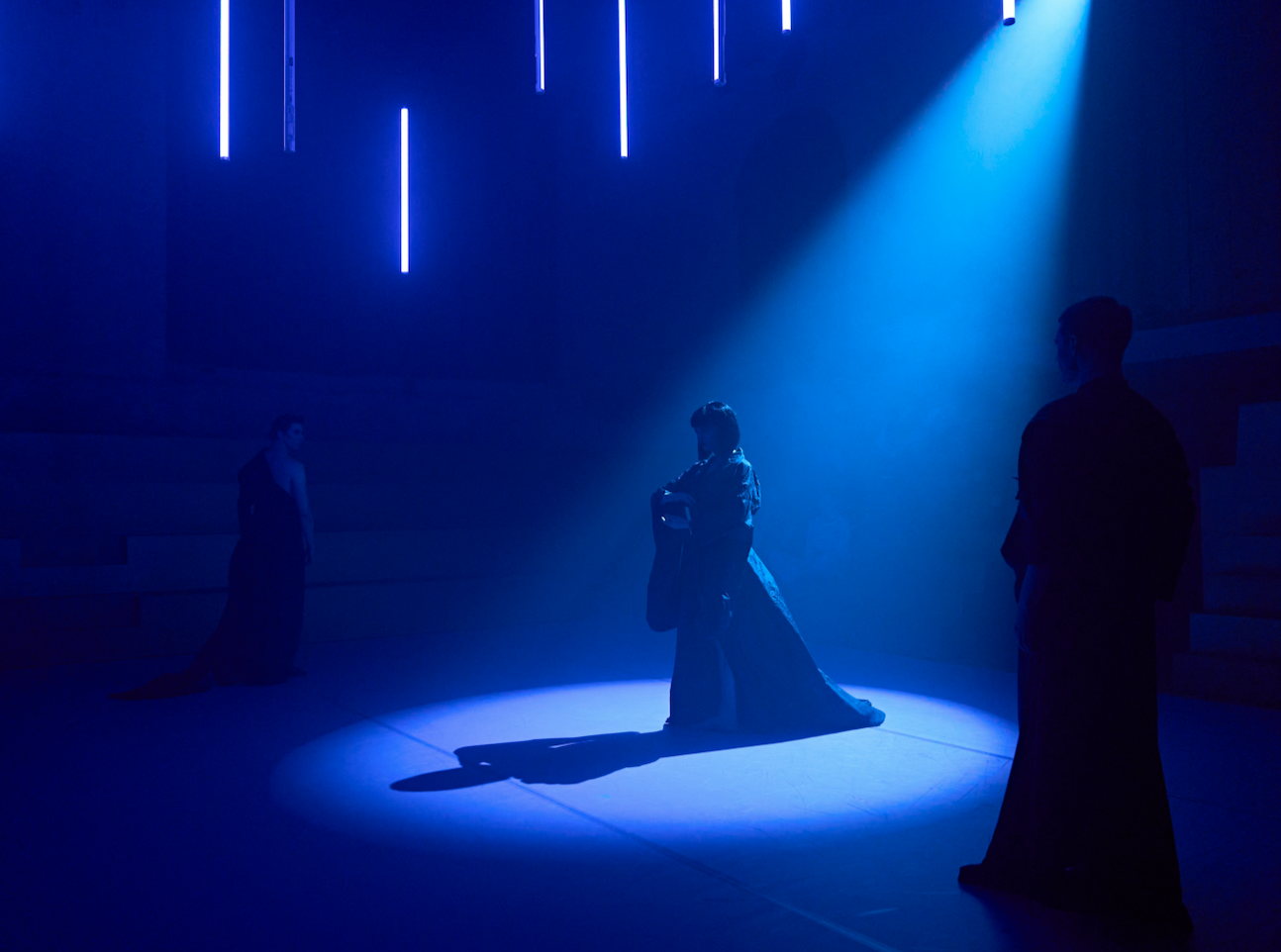
Choreography: Sébastien Bertaud
Music: Jon Hopkins
Lighting: Lukas Marian
With: Nais Duboscq, Pablo Legasa, Daniel Stockes, Alexander Maryianowski
In Ad Astra, Sébastien Bertaud’s new creation, we are immersed in the heart of the Japanese legend of The Moon Princess(Kaguya-hime). Inspired by this tale of mystery and celestial beauty, the dancers capture the dance of the stars and Kaguya’s cosmic journey, evoking gravity and lightness, as well as the duality between the ephemeral and the eternal. Kaguya-hime embodies the fleeting beauty and transient nature of life on Earth, contrasted with the eternity of her celestial existence. The princess Kaguya, descended from the moon, symbolizes the intersection between the earthly world and the infinite heavens, and the legend explores the tension between duty and personal desire. She becomes a metaphor for humanity’s quest to understand the universe. Kaguya’s celestial nature and mysterious powers add a magical, supernatural dimension to the story. The choreography blends ancestral traditions with modernity, creating a visual symphony that pays tribute to the search for meaning and the ephemeral. Kaguya-hime must sacrifice her earthly ties to return home, underscoring the theme of detachment. Each scene is a dreamlike journey capturing the magic of the universe and the beauty of the cosmos. The dance leads us into an exploration of the boundaries between the real and the mythical, capturing the infinite cosmos and the ancestral tales that form part of humanity’s shared heritage.
The legend of the Moon Princess, or Kaguya-hime, is one of the oldest and most famous stories in Japanese folklore, dating back to the Heian period (794–1185). It is told in the tale of Taketori Monogatari (The Tale of the Bamboo Cutter):
“Once upon a time, in a peaceful village of ancient Japan, there lived an old bamboo cutter named Taketori no Okina. One day, while wandering through the forest in search of bamboo, he noticed a stalk shimmering with mysterious light. Intrigued, he approached and, upon cutting the stalk, discovered inside a tiny princess, as beautiful as a cherry blossom. Amazed, he brought her home, where he and his wife, having no children, decided to adopt her and name her Kaguya-hime.
Kaguya-hime grew quickly, becoming a young woman of incomparable beauty. Her grace and charm soon attracted the attention of many suitors, including the Emperor of Japan. Nobles from across the land came to ask for her hand, but Kaguya-hime, true to her heart, refused them all, setting impossible challenges to discourage her suitors. Yet, despite her apparent happiness, Kaguya-hime concealed a deep secret: she was not of this world, but came from the moon.
One day, she confessed to her adoptive parents that she must return to her celestial kingdom. Heavy-hearted, the old bamboo cutter and his wife accepted her fate, though it broke their hearts. On the night of her departure, a celestial procession descended from the sky to take Kaguya-hime away. Clad in a robe of feathers, she stepped into a golden chariot and, before leaving, left a letter and an elixir of immortality for the Emperor, who had loved her sincerely. But the Emperor, overwhelmed with sorrow, refused the elixir and ordered it to be burned atop Mount Fuji, so that its smoke might reach Kaguya-hime in her lunar realm.
Thus, Kaguya-hime returned to her celestial home, leaving behind broken hearts and a legend that endured through the ages. The tale of Kaguya-hime, the Moon Princess, continues to resonate across centuries, reminding us of life’s fleeting beauty and the importance of cherishing every moment.”
This legend, deeply rooted in the culture of the Heian period, reflects the values and concerns of the aristocratic society of the time. It was an era of cultural and artistic refinement, where literary works such as Taketori Monogatari flourished, offering windows into the souls and minds of those who lived then. The legend of Kaguya-hime invites us to reflect on universal philosophical themes. The duality between the ephemeral and the eternal lies at the heart of the story. The transient beauty of Kaguya-hime contrasts with her eternal celestial existence, reminding us of the fleeting nature of human life and the importance of cherishing each moment. The conflict between duty and personal desire is also central, illustrated by Kaguya-hime’s inner struggle between her duty to return to the moon and her wish to remain on Earth with her adoptive parents. The story also highlights the profound relationship between humans and nature. The old bamboo cutter and his wife find happiness through a gift of nature, reminding us of the importance of living in harmony with our environment.
In these times of ecological crisis, the legend resonates as a call to preserve nature and recognize its intrinsic value. The mystical dimension of the story, with Kaguya-hime’s celestial nature and mysterious powers, adds further depth. She symbolizes a connection between the earthly world and the infinite cosmos, inviting humanity to contemplate the grandeur and mystery of the universe. Human fascination with the unknown and the supernatural is beautifully emphasized. Thus, the legend of Kaguya-hime weaves a rich tapestry of philosophical and mystical themes, anchored in a unique historical and cultural context. It continues to captivate and inspire, offering profound reflections on life, nature, and the universe. In times of ecological crisis, this legend resonates as a call to preserve nature and acknowledge its intrinsic worth.
Today, the legend of Kaguya-hime continues to speak to us on many levels. Her quest to understand her true identity and place in the universe echoes our own search for meaning in an age often marked by uncertainty. The recognition of the transient nature of beauty and life encourages us to appreciate each instant and live fully—a message especially relevant in a society often driven by consumption and immediacy.
Adapting the legend of The Moon Princess (Kaguya-hime) into a contemporary choreographic creation carries multiple layers of relevance and interest. The duality between the ephemeral and the eternal can be beautifully expressed through movement, exploring passages of fleeting fluidity and moments of suspension symbolizing eternity. The quest for meaning and the exploration of our place in the universe are universal themes that dance, through its non-verbal language, can render accessible and tangible. Kaguya-hime thus becomes a metaphor for humanity’s search for understanding and transcendence.
Dance, with its ability to express complex emotions, can explore this tension in a powerful and emotional way. The legend of Kaguya-hime also reflects a deep attachment to nature, a central theme in Japanese culture. The themes of the legend are timeless and still resonate today. The choreographic adaptation allows us to revisit these themes from a contemporary perspective, making the story accessible and relevant to today’s audiences.


